In this guide, I will share my experience hiking Piz Boè in the Dolomites, explain what to expect along the trail, and provide practical tips to help you plan your own hike.
Standing at 3,152 meters, Piz Boè is one of the highest peaks in the Sella Group. Besides, it is one of the most accessible 3,000-meter summits in the Dolomites. While reaching many alpine peaks requires mountaineering experience, Piz Boè offers an achievable challenge for hikers willing to put in a few hours of effort.
The trail combines spectacular mountain scenery, dramatic limestone landscapes, and breathtaking panoramic views that stretch across the Dolomites. Whether you are an experienced hiker or simply looking to stand on your first 3,000-meter summit, Piz Boè is a rewarding adventure that deserves a place on your itinerary.
Why hike Piz Boè?
What makes hiking Piz Boè in the Dolomites special? Piz Boè is one of the easiest 3,000 meter peaks in the Dolomites, it is one of the most rewarding hikes. Especially because it takes you to a 3,152-meter summit without requiring technical climbing skills in normal summer conditions.
The reason is, with Pordoi cable car you can be at the summit of Sass Pordoi peak at 2950 m.a.s.l. fast and easily. From the mountain station of the cable car you can reach Piz Boè with approximately one and a half or two hours of hiking. So, it is more accessible to people than other three-thousender summits.
At the top, the 360-degree panoramic views will blow your mind. You can enjoy the stunning views of the Fanes, the Marmolada, the Sassolungo and other summits. The combination of the dramatic Sella Group landscape and panoramic views makes the effort well worth it.
Where is Piz Boè?
Piz Boè is the highest peak of the Sella Group. The Sella Group is a plateau-shaped massif in the center of the Dolomites in northern Italy. It is easily accessible, and is surrounded by four passes: Passo Gardena, Passo Campolongo, Passo Pordoi and Passo Sella.
Its central location makes it relatively easy to combine with other sights and hikes in the area. The valleys around the massif are Val Gardena, Val Badia, Pieve di Livinallongo, and Val di Fassa.
On the summit three provinces border: Bolzano, Belluno and Trento. At the summit of Piz Boè the Rifugio Capanna Piz Fassa mountain hut is located. It is one of the highest located mountain huts of the Dolomites and offers also overnight accommodation, which is open in summer.
How to get there?
You can get there by driving or even with public transportation.
If you arrive by car, Passo Pordoi is accessible by road, although parking can become busy during the peak summer season.
Driving: get to Passo Pordoi. To reach the valley station you shall drive up the Sass Pordoi state road. The Pordoi cable car then can take you up the mountain to Sass Pordoi.
Parking: near the cable car valley station, you will find a paid car park. On the official webpage of the cable car to Sass Pordoi you can find all the information of winter times and summer times, as well as the prices of the cable car.
Public transport options: if you are in the Fassa Valley, using public transport can be fast and efficient. The villages in the valley are quickly reachable by bus. Moreover, from June to September the Dolomites passes are served with buses at regular times, as well.
Route overview
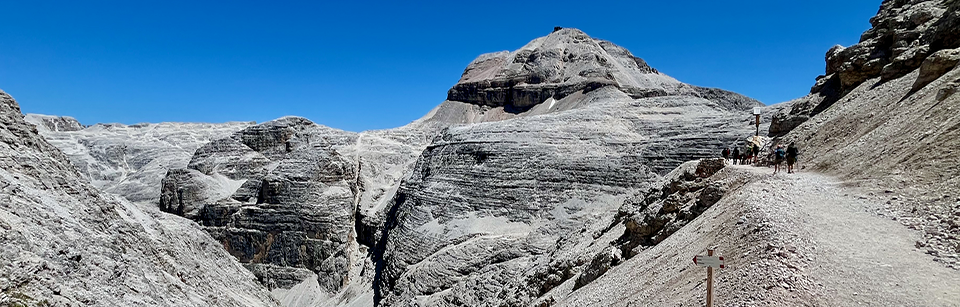
The route from Sass Pordoi to Piz Boè takes you through a spectacular high-alpine landscape, with rocky terrain and almost constant mountain views. Although the distance is not particularly long, the altitude and steep sections make it considerably more demanding than the distance alone suggests.
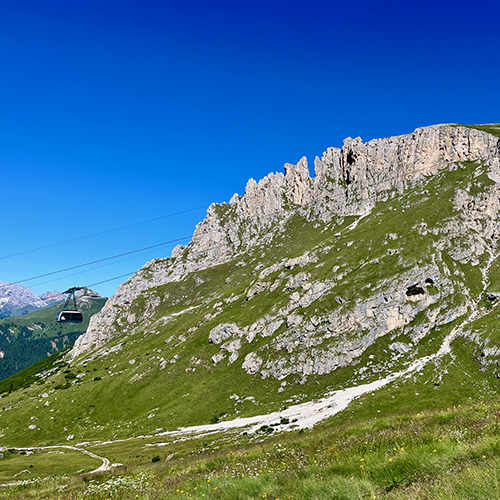
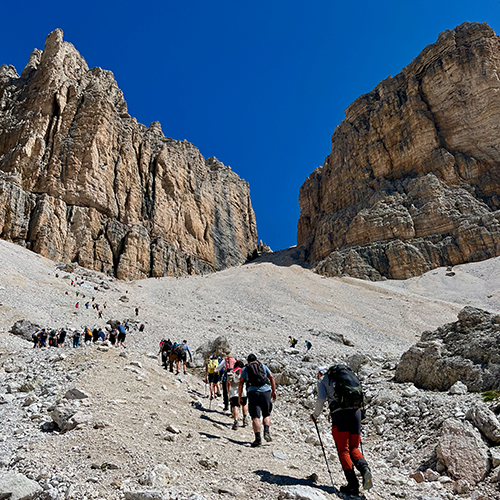
Distance: if you start from Passo Pordoi valley station and hike up to Piz Boè, your hike will take around 13 km there and back. If you go up with the cable car to Sass Pordoi, then from the summit station your hike will take about 7-8 km.
Elevation gain: if you hike from Passo Pordoi, which lies at 2239 meters, up all the way to the summit of Piz Boè at 3152 meters, then the eleveation will be almost 1000 meters. If you hike from Sass Pordoi, which lies at 2950 meters, first you have to descend to Forcella Pordoi at 2848 meters. And from there hike up to the summit of Piz Boè. The elevation will be around 500 meters.
Hiking time: if you hike all the way up and down it will take about 8-9 hours to achieve. If you take the cable car and then hike, the overall time will be 3-4 hours to achieve.
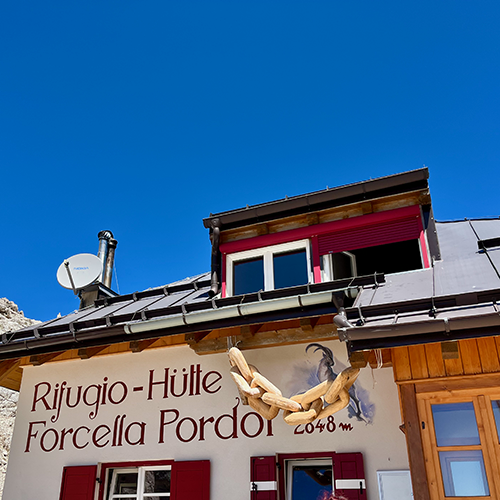
Route type: out and back. From Passo Pordoi the route starts with a long serpentine climb, until it reaches Forcella Pordoi at 2848 meters. There you can find the Rifugio Forcella Pordoi hütte, where you can rest and recharge a little. From there the path leads on a less steep slope. Below the summit a more difficult part comes: climbing the rocks is aided by artificial steps and wire rope installations at several places. You can go back to Passo Pordoi on the same route you came.
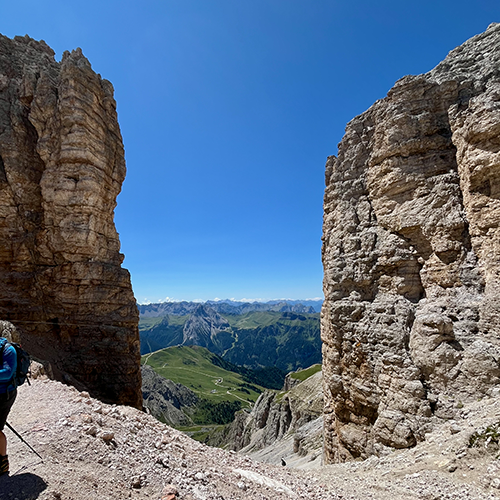
My experience hiking Piz Boè in the Dolomites
Above 2000 meters there are no trees, only apline meadows and flowers and rocks. Mostly you will hike among rocks. Also, there are a lot of people on the route. It is very popular, therefore can be very crowded. So, be prepared that sometimes you have to wait in line, especially below the summit where the wire ropes are.
Don’t be rude and know the unwritten rules of hiking! E.g. one of the most important unwritten rules of mountain hiking is that the hiker going up has priority! This is because it is harder to restart his rhythm if he stops and the physical strain is greater going uphill.
Moreover, when going uphill, a person pays attention to their feet and their own path. It is more difficult to notice those coming from above, while those coming down have a better view of the path and terrain. A person climbing a mountain exerts more force, while for a person descending it is easier to stop or step aside due to gravity.
So, the hiker coming down must politely stop, step aside, and give way! There are some exceptions of course, but please always pay attention to others, as well!
But, back to Piz Boè. This was my third three-thousender peak. The first one was Matterhorn in Switzerland (although just to the hütte at 3260 meters), the second is Acatenango in Guatemala.
I love the Dolomites, it is my favourite mountain range. For me the ascent is more difficult than the descend. On Piz Boè the slopes are steep, but manageable even without hiking poles. If you keep a slower but consistent pace, you will surely get to the top. I think the debris slope is not that difficult to come down if you know how to properly do it. Just don’t be afraid of it.
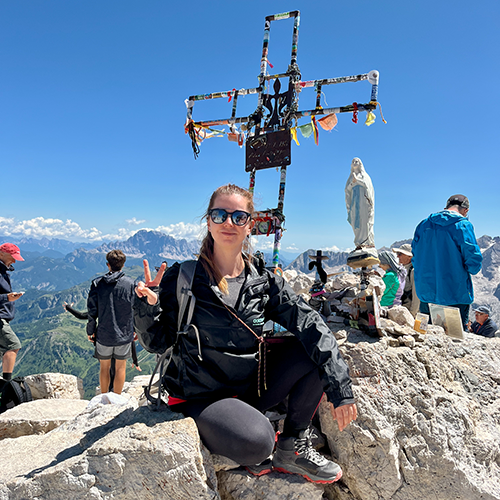
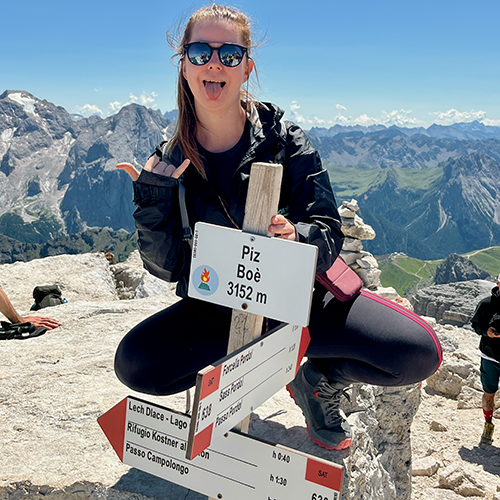
I was very lucky, because the weather was super nice, the sun was shining brightly. At the summit you can easily spend hours. To take photos of the panoramic views, to rest and eat or drink something in the hütte. Or just simply sit down and recharge your batteries.
When I got back down, after 8 hours of hiking I didn’t feel tired. Rather felt the adrenalin in my veins. I even felt like i could do another round. Obviously not, but this hike gave me so much ‘happy hormone’.
Is the Piz Boè hike difficult?
The hike is not technically difficult in good conditions, but the altitude, steep terrain, and rocky sections should not be underestimated. You do not need to be an experienced mountaineer, but a reasonable level of fitness and proper hiking footwear are important.
- fitness level: if you have average fitness level, you will reach the top. Just keep in mind that the slopes are steep.
- rocky sections: the steep slopes are rocky, therefore slippery. There is a section below the summit, where wires will aid your journey. If you have already tried a via ferrata, it won’t surprise you.
- altitude: at this altitude, above 2500 meters altitude sickness can be a thing. It occurs when the body cannot adapt quickly due to the thin air and low oxygen levels. So, if you feel a headache, dizziness, nausea or fatigue, yo have to rest, hydrate and, if necessary, return to lower altitudes.
- exposure: you are exposed almost all the way to the top. There are no trees, so you are exposed to the sun, and the slopes are steep and sometimes you walk next to a precipice.
- who it is suitable for?: if you haven’t been above 3000 meters, this mountain is an excellent choice as a starter.
What to pack?
Even on a warm summer day, conditions at more than 3,000 meters can be very different from those in the valley. Bring plenty of water, snacks, sunscreen, sunglasses, and a warm or windproof layer, as the summit can be cold and exposed.
- hiking boots: that are already worn-in and sturdy that supports your ankles.
- windproof jacket and a pullover: on the summit the wind will blow and if you are sweaty you will need a windbreaker jacket and maybe a light pullover.
- water and electrolytes: you need to retrieve minerals into your body, so you may need electrolytes not just simply water.
- snacks: like müslibar, proteinbar, salty seeds and energy bars or gels.
- sunscreen: take care of your skin and use sunscreen, up in the mountains the sun is much more intense.
- sunglasses or a cap: both can be useful against sun exposure.
- trekking poles (optional): if your knees are weak or you feel safer, bring hiking poles. These can be useful especially when going down on steep slopes.
- travel insurance: it is important to have travel insurance. Anything can happen, hopefully won’t, but can, unfortunately. And the costs of a rescue can be very high, especially if a helicopter is required.
Best time to hike Piz Boè
The easiest time hiking Piz Boè in the Dolomites is generally during the summer when the trail is free of significant snow. However, mountain weather can change quickly even in summer, so checking the forecast before setting off is essential.
Always check the weather and trail conditions before going. Because a route that is manageable in good weather can become much more challenging in rain, strong wind, or snow. Only go when it is safe.
The recommended time of the year to hike Piz Boè is between June and September. As the Dolomites are high mountains the weather can change quickly. Which could make the trail conditions difficult. You can even find snow in summer at higher points and peaks.
Tips before you go
Start early if you want a quieter experience and better chances of enjoying the views without large crowds. Moreover, take into account that maybe you will need more time than you initially calculated.
Check weather forecast, even in the morning before you start. Weather can quickly change in the high mountains and more likely to rain in the afternoon.
Book cable car if needed. Beware, that last ride down is at 17:00 from Sass Pordoi. Prepare your hike around it, if you plan to go down with cable car.
Bring cash, because not all the hüttes accept debit/credit cards.
Do not underestimate the altitude. Bring enough water, and bring a little glucose with you. It can help altitude sickness. If you have a terrible headache and do not feel well, because of the altitude, you shall descend immediately.
If you are in trouble you can call the european emergency number: 112. Or the Aiut Alpin Dolomites, the specific mountain rescue helicopter service.
Do you know about the Dolomites Passport? If you are planning to visit the Dolomites often and plan on hiking a lot there, then it can be a collection of memories. At various restaurants, hüttes and museums you can stamp in your passport that you were there, like in a normal travel document. It is divided into several parts, so, you have to collect them all.
Is hiking Piz Boè in the Dolomites worth it?
Absolutely. For me, Piz Boè is particularly appealing because it gives hikers the feeling of achieving a serious alpine summit without requiring technical mountaineering skills. And the views from the top are spectacular.
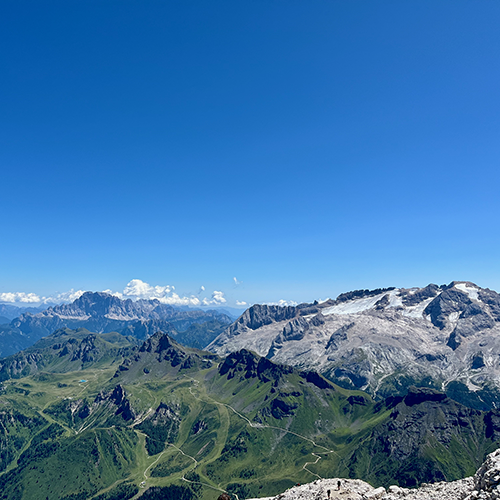
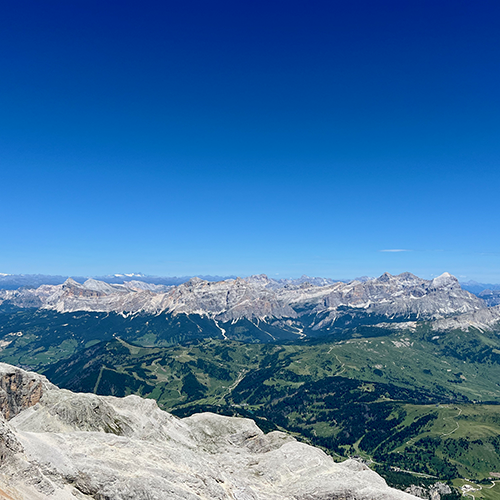
Reaching the summit of Piz Boè is one of those experiences that stays with you long after you’ve left the mountains behind. The hike offers an excellent balance between challenge and accessibility. It makes a fantastic choice for hikers who want to experience a high alpine summit without technical climbing.
Whether you are visiting the Dolomites for a few days or planning a longer hiking adventure, Piz Boè is a route that rewards every step with unforgettable views. With good weather, proper preparation, and a reasonable level of fitness, it is an experience that can easily become one of the highlights of your trip.