
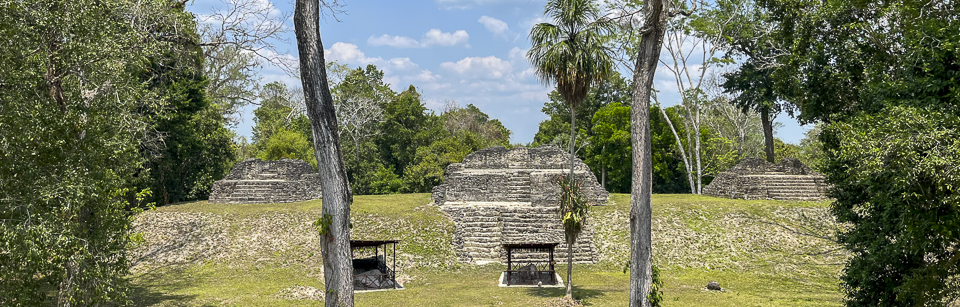
Hidden deep in the jungles of Petén, Guatemala, Uaxactún mayan ruins offer a captivating journey back in time without the crowds. Just north of the famous Tikal ruins, this ancient Maya site blends history, astronomy, and community life. If you’re seeking a quieter, more immersive archaeological adventure, Uaxactún is a destination you don’t want to miss.
About Uaxactún
Uaxactún is one of the earliest Maya archaeological sites in the Maya Lowlands and located in the Petén Department of northern Guatemala. It lies within the Maya Biosphere Reserve in Tikal National Park and was declared a national landmark in 1970. Despite its proximity – only 23 km to the north – to the Tikal site, which is quite popular, only a few visitors explore Uaxactún.
The ancient name of the city was Siaan Ka’an, which means “Born in Heaven”. Its modern name, Uaxactún was given by its rediscoverer, archaeologist Sylvanus Morley in 1916. He took the Maya words Waxac and Tun and put them together. This means “Eight Stones”. Morley found a carved stela with the number 8, therefore he gave the name Uaxactún, or “Stone Eight” to the city.
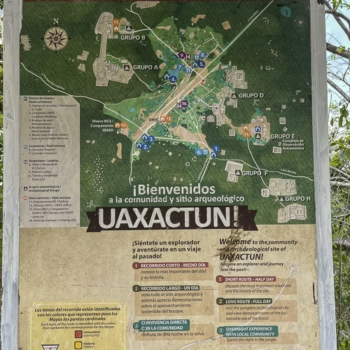
Also, you can find eight architectural groups or complexes (A-H) in Uaxactún. Unlike most ruins, Uaxactún is also a living village with around a hundred and fifty inhabitants. This indigenous community coexist alongside the archaeological zone, an intriguing blend of past and present.
In the middle of the village runs an old airstrip, which divides also the complexes. Groups A, B, and C are located to the west, while groups D, E, F and H are located to the east. Group G is located west of the site and has not yet been shown on maps.
The founder of the Uaxactún dynasty was Wak Kab’ Ajaw’ or “Lord of the Sixth Land,” around 300 BCE. The city was inhabited from the Preclassic period, throughout the Classic period. Until it was abandoned in the Classic Maya Collapse around 900 CE.
Relationship with Tikal
The Maya cities functioned much like modern cities with residential, commercial, political, religious and public spaces. And they also experienced times of growth and decline. But, mayans were not peaceful people, the dynasties were in constant battles with each other. Due to Uaxactún’s proximity to Tikal, these two cities were in continuous competition. Both sites, however, were dwarfed by the large city of El Mirador. El Mirador’s influence extended to the entire Petén region.
At the beginning of the Early Classic Period with the demise of El Mirador, Uaxactún began to expand both architecturally and politically. According to several researchers, Uaxactún played a more significant role than Tikal during the Preclassic period and dominated Central Petén.
Around 90 CE, dramatic events occurred between Uaxactún, an ancient superpower, and Tikal, a rising superpower. In the conflict Uaxactún lost its power and became politically dependent on Tikal for the rest of its history.
In 391 CE, the ruler of Uaxactún, called the Sun Bearer was inaugurated. He was a vassal king of Kalomte’ Sihyaj K’ahk’ or ”Fire is Born”. He marched in Tikal and he claimed control of the city, and proclaimed himself king.
After the change in the Tikal dynasty, the leader of this new power moved to Uaxactún. It is likely K’ihnich Mo’ was the Teotihuacan military captain who became leader in the city of Uaxactún. The “La Entrada” (The Entrance) had an impact on the history of Uaxactún. Though, this began a dynastic line of kings who greatly expanded the city and its wealth. In 562 CE Tikal suffered a devastating defeat by Calakmul, which negatively affected Uaxactún, as well.
What to see in Uaxactún
Though smaller and lesser-known than Tikal, Uaxactún is a treasure trove of ancient Maya architecture, astronomy, and jungle scenery. Here are what stand out:
Group E – The Maya Observatory
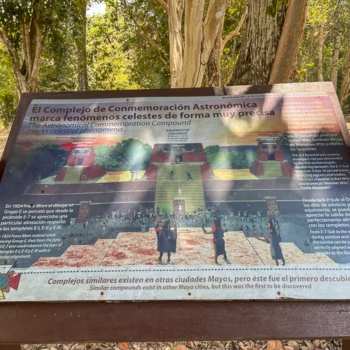
Uaxactún is the first archaeological site where the Maya corbelled arch was observed. Moreover, it is also considered the first archaeological site where the Maya observed the spring equinox. Thus it is home to the oldest astronomical observatory in Mesoamerica.
One of the most famous attractions in Uaxactún, Group E is considered to be an ancient solar observatory. The structure was used to track solstices and equinoxes, which is evidence of the advanced astronomical knowledge of the Maya. The oldest group in the city is this Group E. Archaeologists refer to the astronomical complexes in Mayan cities as Group E, because of this first complex in Uaxactún.
The triadic arrangement of pyramidal structures align to the solstices and equinoxes when viewed from a certain point (what you can see on the cover image). This placement of the pyramids allowed the Maya to observe astronomical events, which in turn helped them determine agricultural, seasonal, and ritual events.
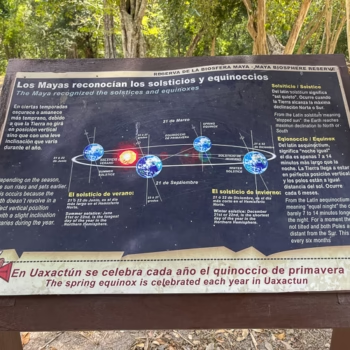
Later, to the south of this group, another triadic complex of structures was built, forming the first acropolis of Uaxactún. It was initially built on a lower area than the plaza of Group E. Therefore, it is known as the Sunken Plaza.
Group A and B
Later a new triadic acropolis was built on higher ground, where Groups A and B are located. These new structures marked the beginning of development of the area.
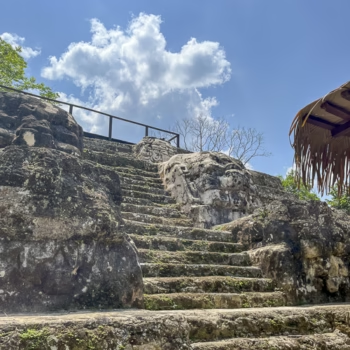
Group A is the largest building complex at the site. The buildings that are visible today are mostly from the Classic period (200-900 BC), and are located around the Main Plaza. On the Main Plaza interesting stelae can be found, including the oldest. The Acropolis is at the opposite of the plaza and consists of several structures. This was the political center of the city.
In Group B a ball court was discovered, and this is the only one at the site.
Group H
It consists of two plazas oriented on a north/south axis. At the South Plaza there are some fabulous early structures that had been buried by later constructions with large stucco masks and decorative facades. Also, you can find six temples built on top of a small acropolis.
On the north side of the acropolis there is a triadic arrangement of three small pyramid-shaped structures.
Group H was buried and abandoned in the second century BC.
Wildlife and Jungle Ambience
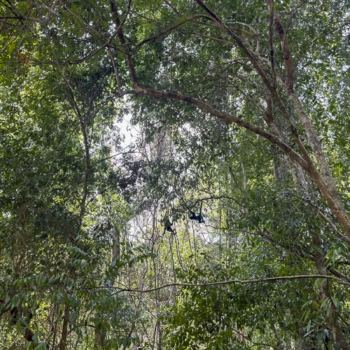
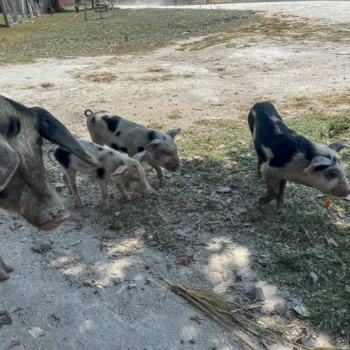
In Guatemala, Uaxactún mayan ruins is less developed and has less visitors than Tikal, so, you will walk through more authentic jungle terrain. Expect to see toucans, howler monkeys, colorful butterflies, and maybe even coatimundis. The overgrown paths and mossy stone structures create a raw, Indiana Jones-style vibe. It is possible we even passed by a snake, we only heard that something is rattling under the leaves. We also saw some pigs in the village.
How to get to Uaxactún and entry info
Tikal National Park is open daily for visits from 6:00 AM to 5:00 PM.
Adult tickets for foreigners cost 150 GTQ for entering Tikal. Visiting Uaxactún costs 50 GTQ. If you want to see both Tikal and Uaxactún, you have to pay both, so, 200 GTQ. If you just want to go to Uaxactún, you just have to pay the fee, 50 GTQ for Uaxactún.
We hired transportation from the same travel agency at the Bus Terminal in Santa Elena, as when we went to Tikal.
Uaxactún is about 23 km (14 mi) north of Tikal, but road to the site is not in a very good condition. It took a lot of time to get there. We travelled with a shuttle bus from Flores, with people who went to see Tikal. If you stay in Tikal, you can book a tour to Uaxactún there.
Travel tips
Because of the long transportation, we got there at the middle of the day, and it was a very hot day. Make sure you bring plenty of water, snacks, and insect repellent. You can find a shop in the village, but it is very very small with limited sortiment.
Wear good walking shoes, the jungle trails can be slippery and uneven.
Go in the dry season, from November to May. If you go in the rainy season (May-Nov), check road conditions, they can become muddy and harder to pass.
We went without a guide. But maybe it is better to hire one, because they can share history insights and interesting stories.
You can stay in Tikal for a night, so, you can explore both Tikal and Uaxactún. You will not be able to do both in one day.
In Guatemala, Uaxactún mayan ruins may not be as famous as its neighbour Tikal, but its historical importance and tranquil atmosphere make it a standout for curious travellers. Whether you are fascinated by ancient Maya astronomy, eager to experience local village life, or simply want a break from the tourist path, Uaxactún mayan ruins in Guatemala offer a truly enriching visit. Sometimes, the most rewarding places are the ones where few others go.

